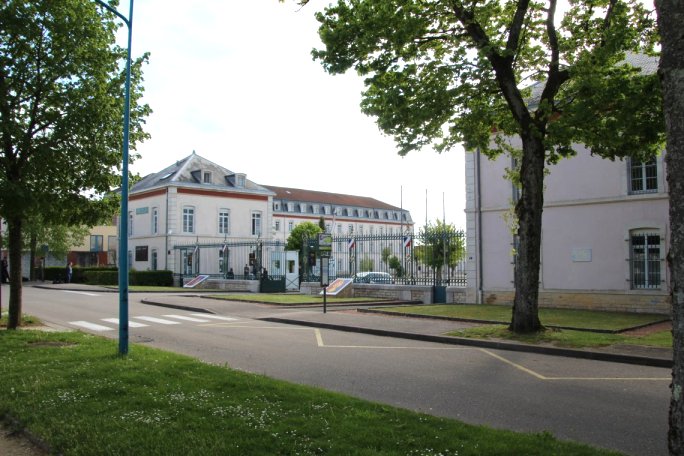
Pershing's HQ in Chaumont is now a police training facility, at the time of my visit, inaccessible to the public.
Pershing's HQ in Chaumont is now a police training facility, at the time of my visit, inaccessible to the public. |
Although the Central Powers knocked Russia out of the war in 1917, their blockaded economies were tettering on the brink of collapse and their spring 1918 offensives in France were halted in desperate fighting. In places like Chateau Thierry and Belleau Wood, American manpower helped stop the Germans. Perhaps as important, the arrival of the Americans boosted the morale of the Allies, who now knew that victory was inevitable. Although the commander of the American Expeditionary Force John J. Pershing had allowed American units to be detached for the emergencies of the spring and summer of 1918, he had strict orders to fight his army as a united army, not as auxiliaries of the French and British. America, in fact, was an associated power, not one of the Allies, and President Wilson had more idealistic goals than the bloodied Allies. |
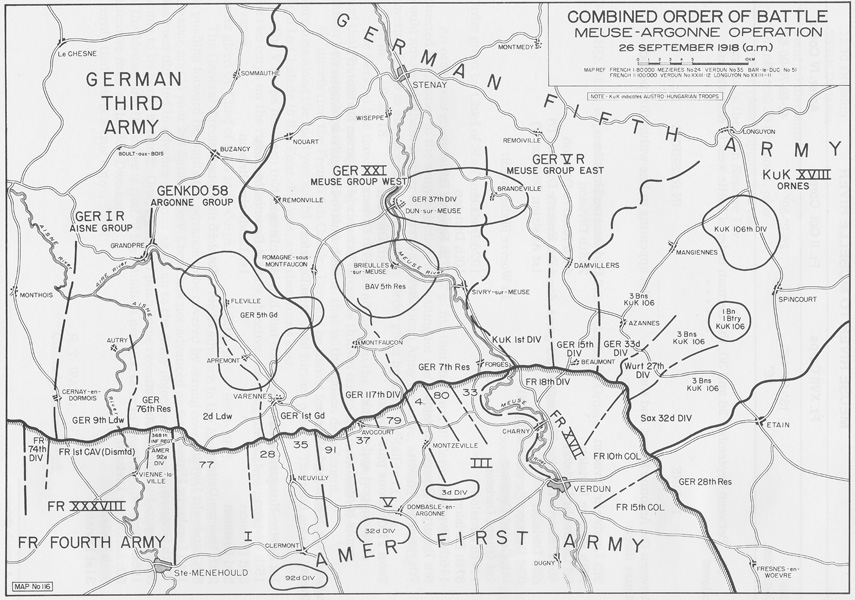
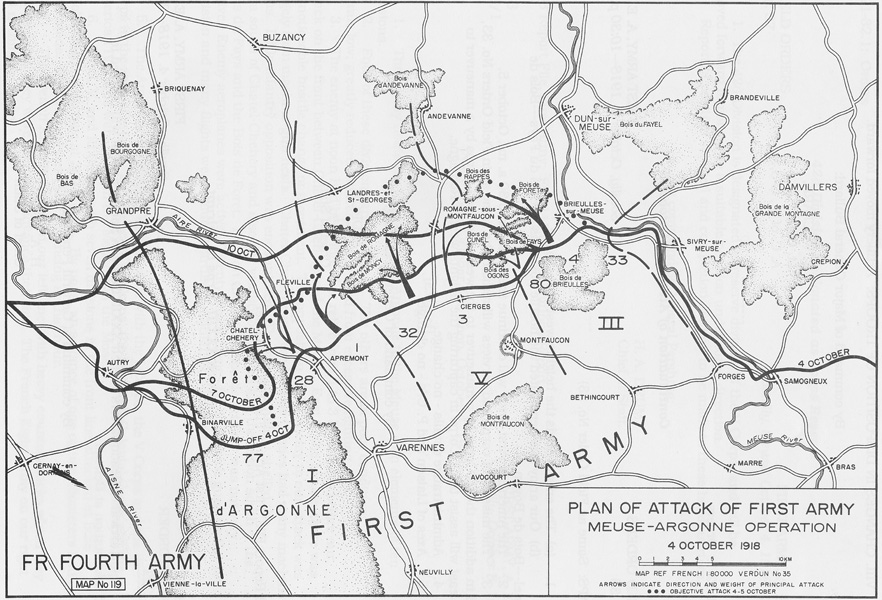
With the repulse of the German offensives and the success of Allied counter-offensives, supreme commander Ferdinand Foch planned a general attack. The Americans were supplied from ports in the west of France - to simplify the lines of communication, the American army massed near Verdun, south of the bulk of the Allied forces. As part of a previous plan the Americans, with French help, reduced the St. Miheil Salient south of Verdun, a salient which had cramped the supply of Verdun since the early battles of 1914. The Germans evacuated the salient during the offensive, and the Americans gained a quick success. Rather than continue the attack toward Metz to the east, which would threaten German rail transport, industry, and coal mines, the Americans shifted their attention north to the Meuse-Argonne sector in accordance with Allied wishes. Although this planned new offensive is sometimes described as following a massive shifting of troops, few troops were moved from the St Mihiel area as the new Meuse-Argonne operation had been in the making for some time. Now the Americans would attack north through rolling hills and forests studded with four lines of German fortifications. Sedan, the ultimate objective, was a point of enormous strategic importance. The railroad through Sedan was used by the Germans to supply their armies in France. If Sedan could be captured, perhaps a decisive victory could be won. Nine American divisions, each twice the size of European divisions, vastly outnumbered the German - an 8 to 1 advantage. On the right flank French divisions would attack on the east side of the Meuse River. On the left flank, the French 4th Army attacked. A three hour bombardment from 2,775 guns along a 40 km front announced the offensive at 2:30 am on September 26th. Although first day objectives were not met, progress was good, with the advance passing Montfaucon on both sides. The hilltop town would fall the next day, but the delay caused by Montfaucon allowed the Germans to bring in reinforcements, with seven divisions being added to the five already there. Progress slowed around Romagne Heights, but on October 5th an attack forced the Germans to fall back from the Argonne Forest. On October 6th, an attack east of the Meuse helped relieve flanking fire from the Meuse Heights. German and American reinforcements were brought in. On October 14th, the Americans broke through the Hindenburg Line. A decisive attack on November 1st convinced the Germans to fall back behind the Meuse. |
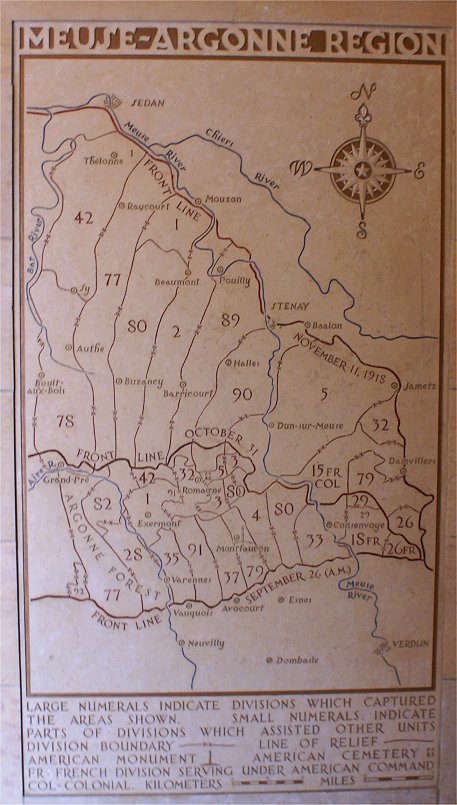 |
| By November
11th, doughboys were overlooking Sedan and the railroad that supplied
the German army in France, but French and British progress
elsewhere
along the front meant that cutting the rail line no longer held the
importance that it once did. The great American contribution to
the
Allied offensive had been drawing German reserves that otherwise
would
have faced the advancing British and French armies. Although it
perhaps does not reflect this drawing in of German reserves, this
French animated map gives the bigger view, showing the disappearance of
German reserves. Elsewhere in the
world, the Ottomans
had exited the war, and following an Allied breakthrough in the
Balkans, Austria-Hungary made peace, abandoning Germany and
leaving them to potentially face an attack from the south. On the
Western Front the Allied and
American armies had put enough pressure on the Germans to shatter the
morale of the men in the ranks and force their commanders to commit
most
of their reserves. German divisions were ground down to skeletons
of their former selves. Any additional defeats would be
catastrophic.
Although some Germans after the war would deny it, Germany was
well
and
truly beaten on the battlefield and was on the verge of political and
social revolution.
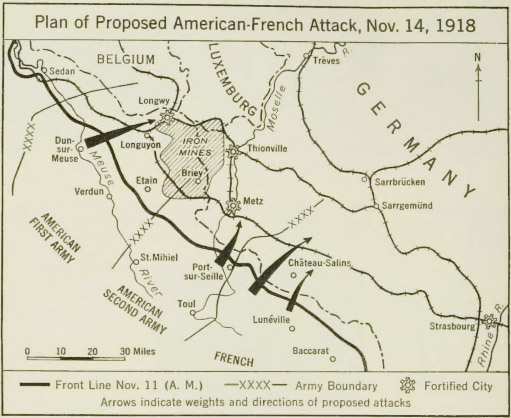
Three days before a planned major offensive on November 14th, an
offensive that was to include an American advance toward Metz that
included the landing by airplanes of special attack troops, the
Germans
signed
an armistice in Marshal Foch's rail car at Compiegne. The
"War to End All
Wars" was over - the Kaiser had been forced to abdicate
and America was now a major world power. |
 |
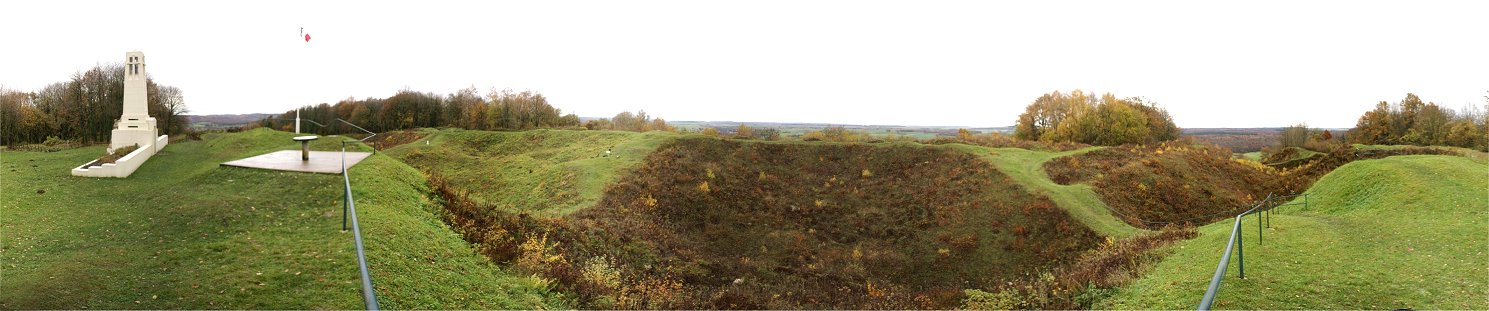
| The scene of stagnant mine warfare that had blown the top off a hill,
creating two ridges, Butte Vauquois was one of the difficult areas in
the American attack sector, and it dominated the land below it.
The Americans of the 35th Division abandoned the trenches
here on the hilltop five hours before the attack. The bombardment
of the hill was intense. When it lifted, two American
companies advanced immediately behind the barrage, killing and
capturing the Germans as they emerged from their bunkers.
Meanwhile, Americans on either side of the butte penetrated the
German line. |
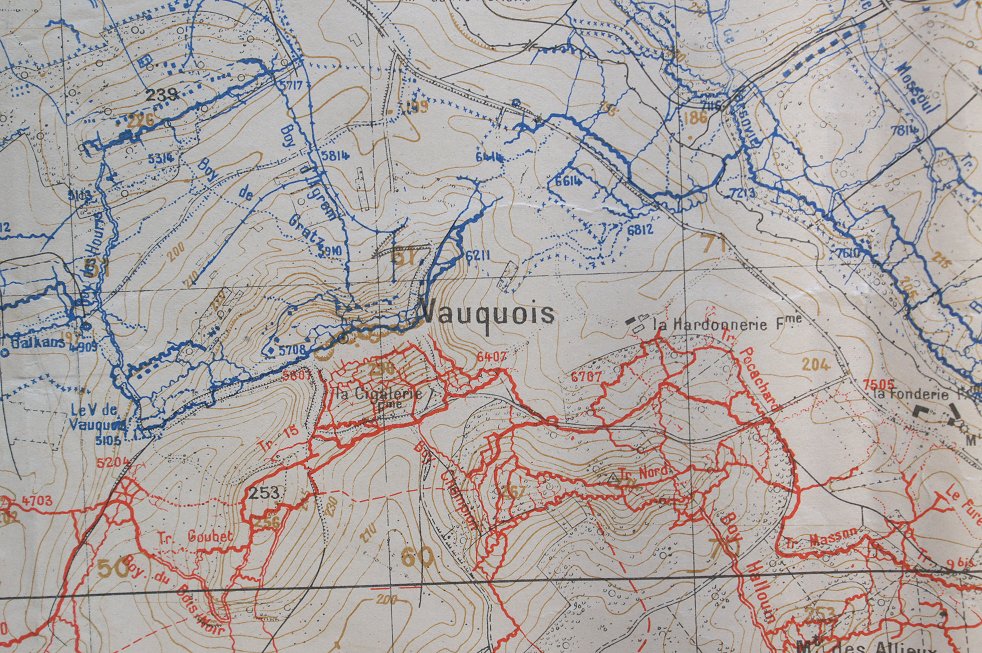 1918 Trench Map From George C. Marshall Library |
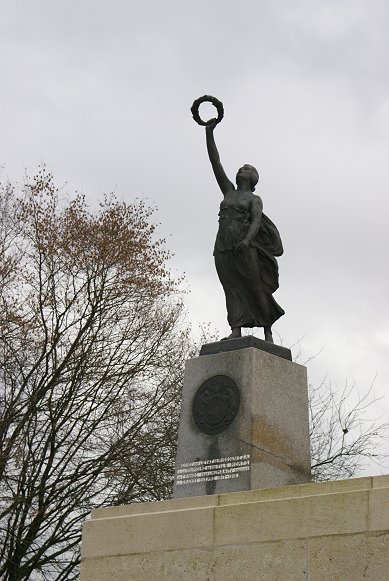
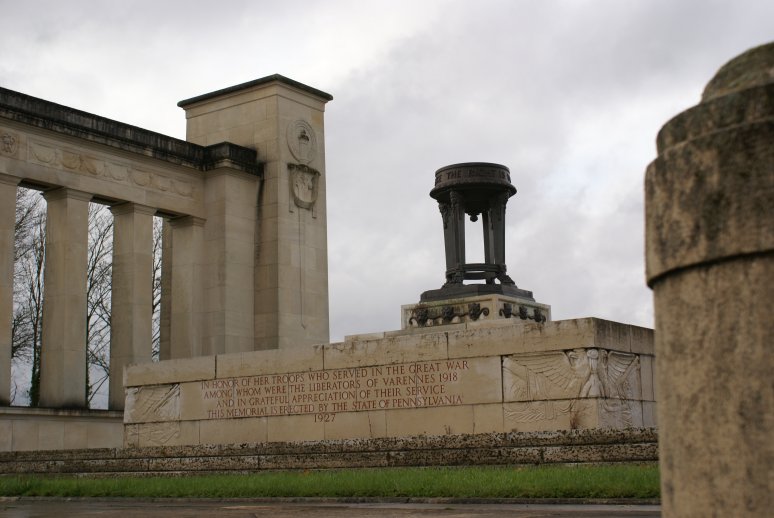

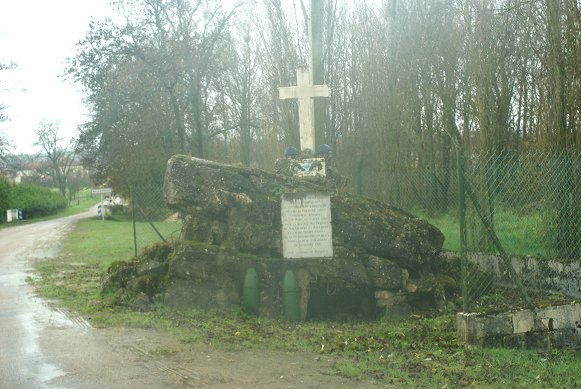

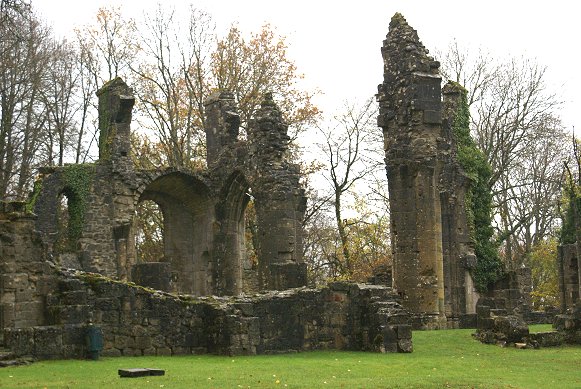
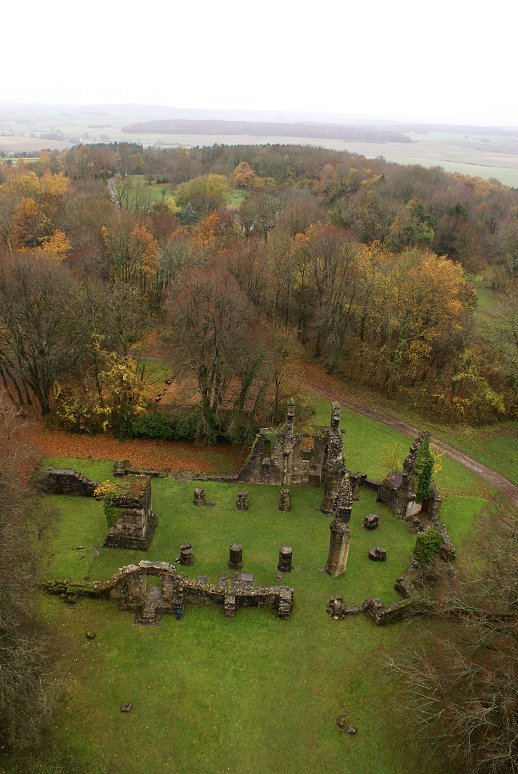
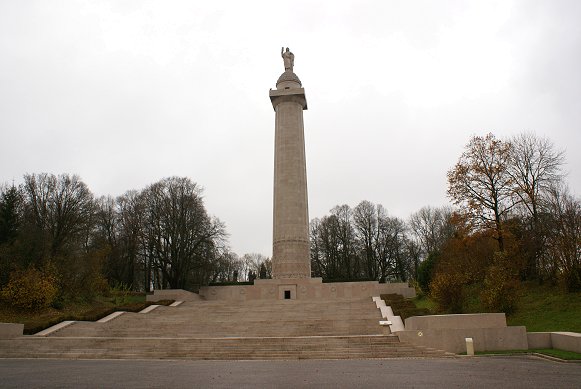

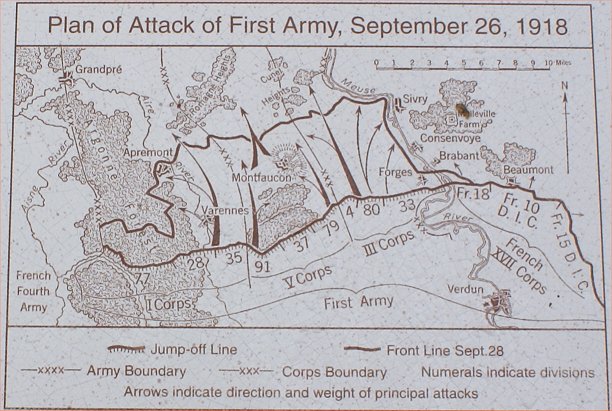
Road at left extends to Consenvoye on the Meuse. Le Mort Homme and
Hill 304 were bitterly contested during the 1916 Battle of Verdun.
Verdun is something over 10 miles to the southeast. The 79th Division
attacked from Malancourt, skirting the Bois de Monfaucon, with the 37th
and 91st Divisions attacking through the forest. The 35th Division
captured Butte Vauquois. Varennes was the approximate border of that
division and the 28th, which attacked through the Argonne Forest.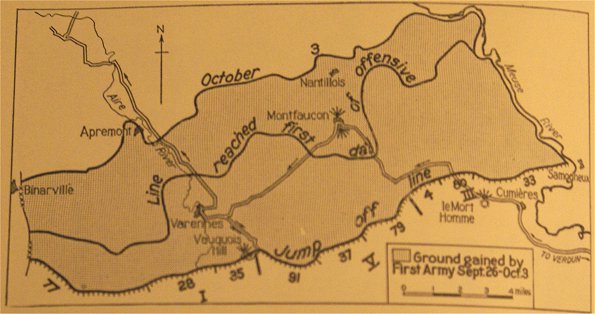 |
 |